



Bible, History, Archaeology
History,
Archaeology
Home > Old Testament > The Story >
Did camels exist
in biblical times?
Contents:
Introduction - Camels in Giza - Conclusion - Camels in the Ancient Near East -
Five reasons why domesticated camels likely existed
Introduction
By Megan Sauter, Editor-in-Chief of the journal Biblical Archaeology Review Biblical Archaeology Society, Washington, D.C.
Certain biblical texts, such as in Genesis (Genesis 12:16, 30:43, 32:7, 32:14-15, etc.), state that Abraham owned camels. Camels play a major role in the biblical narrative of the patriarchs; these animals are mentioned more than 20 times in Genesis alone. However, some archaeological research indicates that camels were not domesticated in the southern Levant until the 10th century BCE, which is about a thousand years after Abraham's time. This seems to suggest that the camels in these biblical narratives are anachronistic, to the point that some claim the biblical text was compiled long after the events it describes.
Dr. Mark W. Chavalas, a professor of History at the University of Wisconsin-La Crosse, explores the history of camel domestication.
Although he acknowledges that the domestication of camels likely only took place in Canaan in the 10th century BCE, He notes that Abraham's place of origin was not Canaan, but Mesopotamia.. Thus, to determine if Abraham's camels are anachronistic, one must ask:
When were camels first domesticated in Mesopotamia?
Dr. W. Chavalas explains that the events in the biblical narratives of the patriarchs and matriarchs (Abraham and Sarah, Isaac and Rebekah, and Israel and Rachel) have traditionally been dated from approximately 2000 to 1600 BCE (during the Middle Bronze Age).
Camels already appear in Mesopotamian sources in the third millennium BC. However, the mere presence of camels in the sources does not necessarily mean that camels were domesticated.
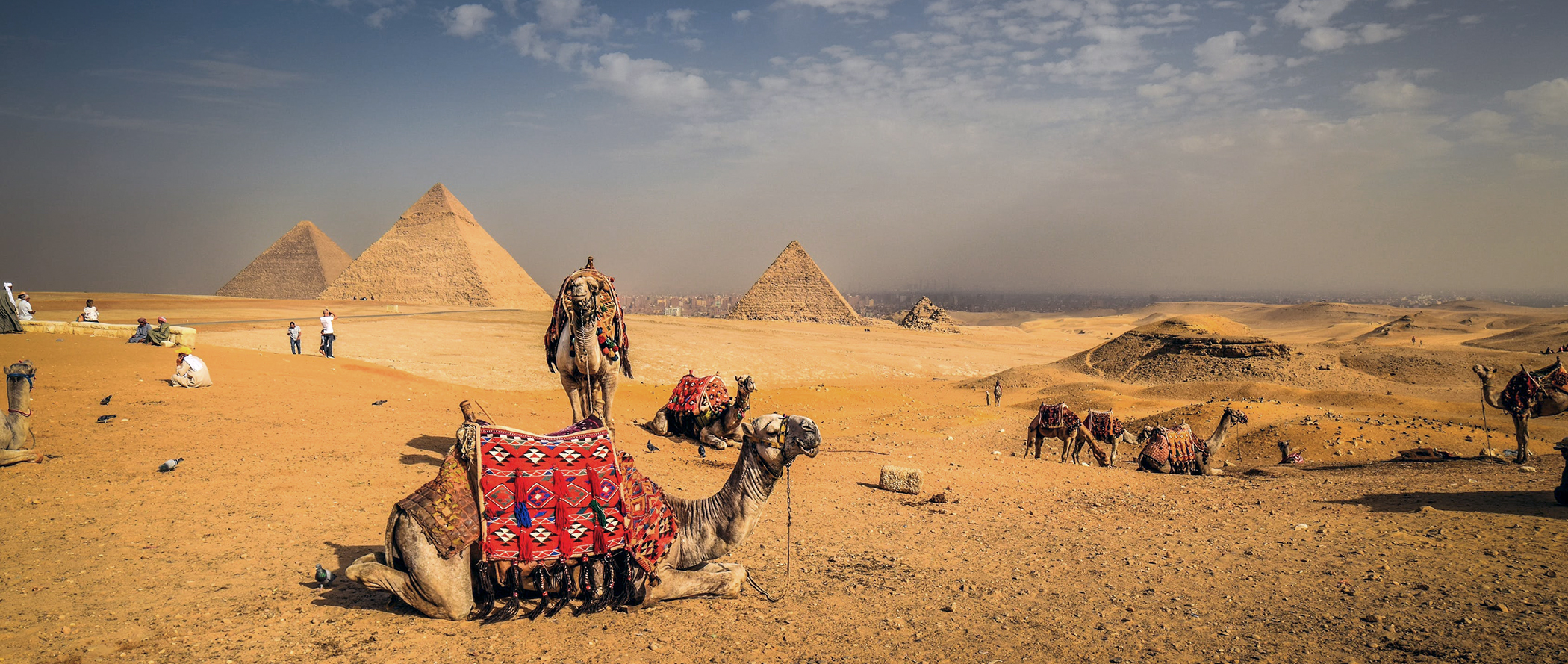
Camels in front of the pyramids of Giza in Egypt.
Archaeological discoveries shed light on the history of camel domestication, suggesting it took place in Mesopotamia as early as the second millennium BC. Image © Théo Truschel.
The question remains: when were camels domesticated in Mesopotamia?
In his investigation into the history of camel domestication, Chavalas examines a variety of textual, artistic, and archaeological sources from Mesopotamia dating to the third and second millennia BCE.
We will examine five of these sources here:
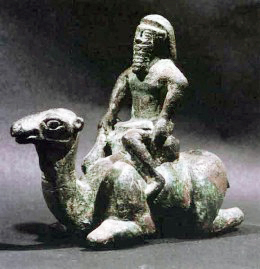
1 – One of the first pieces of evidence The domestication of camels comes from the site of Eshunna in modern-day Iraq: a plaque from the mid-third millennium shows a camel ridden by a human.
2 – Another source is a 21st-century BC text from Puzrish-Dagan in modern Iraq that may record camel deliveries.
Thirdly, an 18th-century BC text (citing an earlier third-millennium text) from Nippur, modern-day Iraq, says: «Camel milk is sweet. Chavalas explains why he thinks it probably refers to a domesticated camel.
Having surveyed many herds of camels in Syria along the middle Euphrates River, I believe this text describes a domesticated camel; Who would want to milk a «wild camel» At the very least, the Bactrian camel (with two humps) was used for dairy needs during that era.
Image below: This impression of an 18th-century BC Syrian cylinder seal depicts a two-humped camel with riders. The seal and other archaeological finds shed light on the history of camel domestication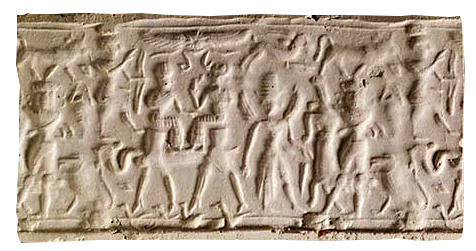 Meaux. Image © The Walters Art Museum, Baltimore.
4 - Next, a cylinder seal from the 18th century BC depicts a two-humped camel with riders. Although the exact origin of this seal is unknown, it is thought to be from Syria and resembles other seals from Alalakh (a site in present-day Turkey, near Turkey's southern border with Syria).
5 – Finally, a 17th-century text from Alalakh includes camels in a list of domesticated animals requiring food.
Conclusion
Although domesticated camels may not have been widespread in Mesopotamia in the second millennium, this evidence shows that domesticated camels did exist. Thus, camel domestication had occurred in Mesopotamia by the time of Abraham. Consequently, Chavalas argues that the camels in the Abraham narratives in Genesis are not anachronistic.
Camels in the Ancient Near East
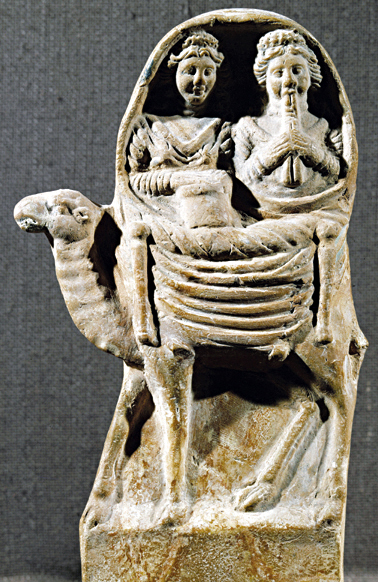 By Noah Wiener of the journal Biblical Archaeology Review Biblical Archaeology Society, Washington, D.C.
Once domesticated, camels greatly facilitate travel across the rugged and arid terrains of the Near East and North Africa (Genesis 12:16). Carrying up to 1,000 pounds on their backs, camels can travel about 25 to 30 miles a day and go for weeks without drinking water. A thick lining in their mouths allows them to eat almost anything digestible, even thorny bushes—and a special, nearly transparent eyelid enables them to see while protecting their eyes from blowing sand. Camels also provide their owners with milk (females can produce nearly four quarts a day for up to 18 months after giving birth) and fuel (dried dung).
Thanks to such perfectly adapted creatures, the desert peoples conducted a lucrative trade in incense, myrrh, saffron, and cinnamon—a trade entirely dependent on camel caravans crossing Arabia to the Mediterranean coast.
Camels as beasts of war
Camels were also important war animals. The 5th-century BC Greek historian Herodotus tells how camels played a decisive role in the victory of the Achaemenid Persians under Cyrus II over the Lydians of Anatolia, led by Croesus, in 546 BC: «The reason for confronting the Lydian cavalry with camels was the instinctive fear they inspire in horses. No horse can bear the sight or smell of a camel. It was on this point that the stratagem rested, and its objective was to render Croesus's cavalry useless, the very weapon in which the Lydians expected to distinguish themselves. The ruse succeeded, for when the battle began, the horses took flight as soon as they smelled and saw the camels – and Croesus's main reliance was cut out from under him.» (The Stories 2.80).
Find out more
Theo Truschel, The Bible and archaeology.
This lavishly illustrated book presents the biblical story from Abraham to the apostle John and his Apocalypse.
Its originality stems from the paralleling of biblical tradition with historical figures, from both the First and New Covenants, situated in what we know today of this civilization and those of the surrounding countries. Questions about the writing and transmission of documents are addressed in the very first chapter.
Numerous richly illustrated hors-texts present archaeological discoveries in Israel, Egypt, Iraq and Iran, and their sometimes controversial interpretations. They deal with the specific study of sites (Samaria, Mount Ebal, Tanis, Elephantine Island), certain stelae (Mesha, Tell Dan, Merenptah) and various exhumed objects (ivory grenade).