



Bible, History, Archaeology
History,
Archaeology
Home > Old Testament > The Story >
Marriage in Biblical Israel
The Old Testament
Contents:
Introduction - The promise - The engagement - Illustration of a ceremony - The wedding - Marriage, an alliance - Polygamy
Introduction
If the first miracle performed by Jesus takes place within the context of a marriage (The Wedding at Cana, John 2:1), and if this custom appears as an important element in the Lord's parables (The parable of the ten virgins, The wedding of the king's son, For example, in the Torah (the Law given to Moses by God), he compared himself to a husband (Matthew 9:15); strangely, the Mosaic Law leaves no directive regarding its implementation. However, the Talmud (oral transmission that accompanied the biblical history of the First Covenant and was transcribed from the 2nd to the 5th centuries AD) provides us with some precise details that wonderfully corroborate the few elements reported in the New Testament.
The ancient Jewish traditions allow us today to reconstruct the marriage in its three phases:
The promise
It was a simple engagement that was not final. It could be broken before the engagement. The young people would get to know each other and decide whether they wanted to move on to the real engagement. Sometimes the father would have his daughter, even without her consent, but the engagement could be broken. If the girl was of age, her consent was necessary. 1.
1. Kiddouchin, 41 a. (Treaty of the Mischna and the Talmud).
The engagement
A most important act, the ring was given. The period lasted a year (unless the fiancée was a widow) and was as definitive as the marriage itself. The fiancée could be stoned, like a woman who committed adultery, if she failed to keep her promise. A whole ceremony took place that tied the commitments made and gave them an absolute character.
Image below: a ketoubah. This is a Jewish marriage contract, traditionally written in Aramaic, which sets out the husband’s obligations to his wife, including material support and financial compensation in the event of divorce or death. Public domain.
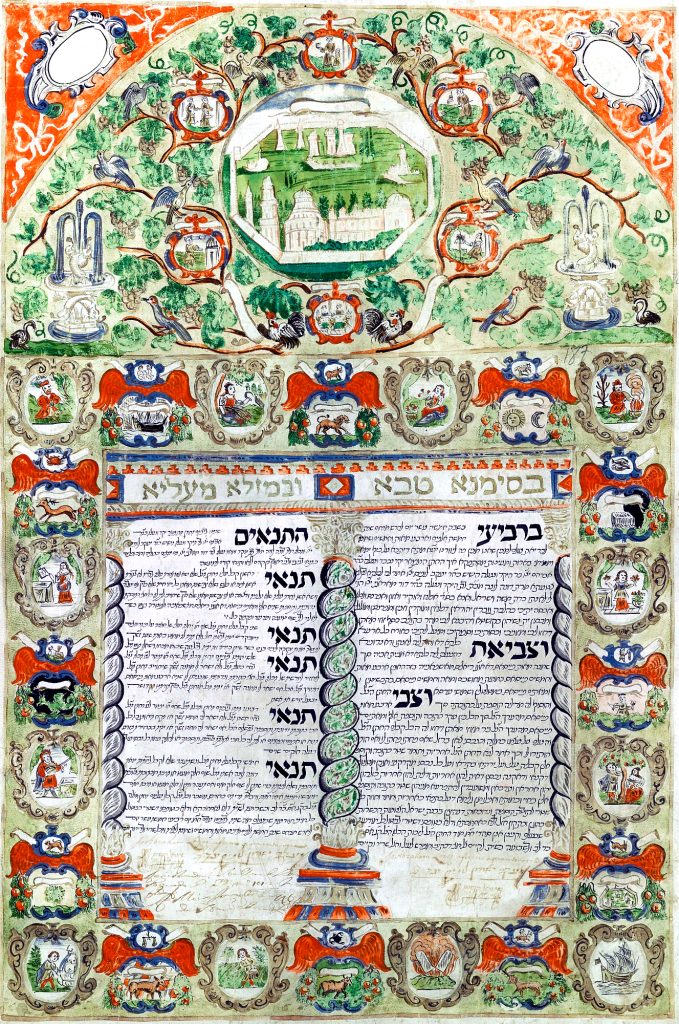 In ancient Israel (Old Testament), there was no religious ceremony; the blessing of parents and attendants was given only to the newly married couple; engagement was simply by giving a promise. One engaged in a loud voice (Ezekiel 16:6; Malachi 11:14). Starting from the Exile or the time of Ezra, the practice of written documents signed by both parties became common. 2.
2. This writing, which stipulates the husband’s promises to his wife, is called Ketoubah.
As for free unions, common practices in some surrounding ancient civilizations, the Talmudic laws strongly condemn them. 3.
The important question was not whether the young people knew each other, because often they had never met before. 4 And nothing was unusual like marriage of inclination. It was simply a matter of setting the price that the young man would give for his future wife, or the price at which he would buy her, because these marriages, where it was not the father who endowed his daughter, but the fiancé who brought money, were considered to be real «sales». The parents and friends negotiated among themselves the amount that the young girl was considered to be worth, and the gifts she was to receive. This transaction is called Mohar 5.
The young girl’s father indicated the amount, and it was up to the young man to accept it or reject it. If he accepted it, he would pay off his debt either in money or in kind. Sometimes he would serve his future father-in-law and the duration of this service was the duration of the engagement. 6 as in the case of Jacob. However, the romantic feeling was not absent from these considerations, as we are told that « Jacob worked for seven years to get Rachel and those years were like a few days in his eyes because he loved her. »(Genesis 29.20). The feeling of love was widely recognized and celebrated in Israel; just read the Song of Songs to discover the flame of love there, and although it is interpreted as God’s love for his people, or Christ’s love for the Church, it does contain some carnal aspects that are mentioned very directly and without any pretense, because they were accepted without any problem in the mentality of the time.
The engagement ceremony was thus held: the two families met with a few foreign witnesses 7 and the fiancé would give the fiancée, or her father, if she was a minor, either a gold ring 8, either an object of price, or finally a simple written declaration by which he undertook to marry her; then he told her: «Here, by this ring (or this object) You have consecrated me according to the Law of Moses and Israel ».
Then they allowed at least a year to pass; but the ring was given away, and only divorce or death could separate the future spouses. The Talmudic sources give a singular reason for this long period of engagement: the young girl had to be left to herself. «the time to make a collection» 9.
If the fiancée was a widow, the time was reduced; however, she had to wait at least one month. Moreover, the fiancé was exempt from military service and from one year after the final promise of marriage; young men were not required to attend funerals or enter cemeteries:« Only joy must fill their heart »It goes without saying that a feast of rejoicing ended the day.
In the time of the Mishnah, around the 3rd century CE (in Hebrew: «repetition», the first collection of the oral Torah, of rabbinic literature), the practice of the father giving a dowry to his daughter began to take hold. The Talmudic texts later made it an obligation. 10. The engagement was over; the wedding was celebrated.
3. Kiddouchin 12 b. (Treaty of the Mischna and the Talmud).
4. Genesis 24.3-4; 38.6.
5. If the obligations towards the bride were not fulfilled, she could leave her husband.
6. Genesis 29.18, 27; 34.12. See also 1 Samuel 28.25-27; Hosea 3.2; Joshua 15.16-17.
7. Kiddouchin, 63 a.
8. Ketouboth I,I.
9. Ketouboth 5,2.
10. Ketouboth 52, a.
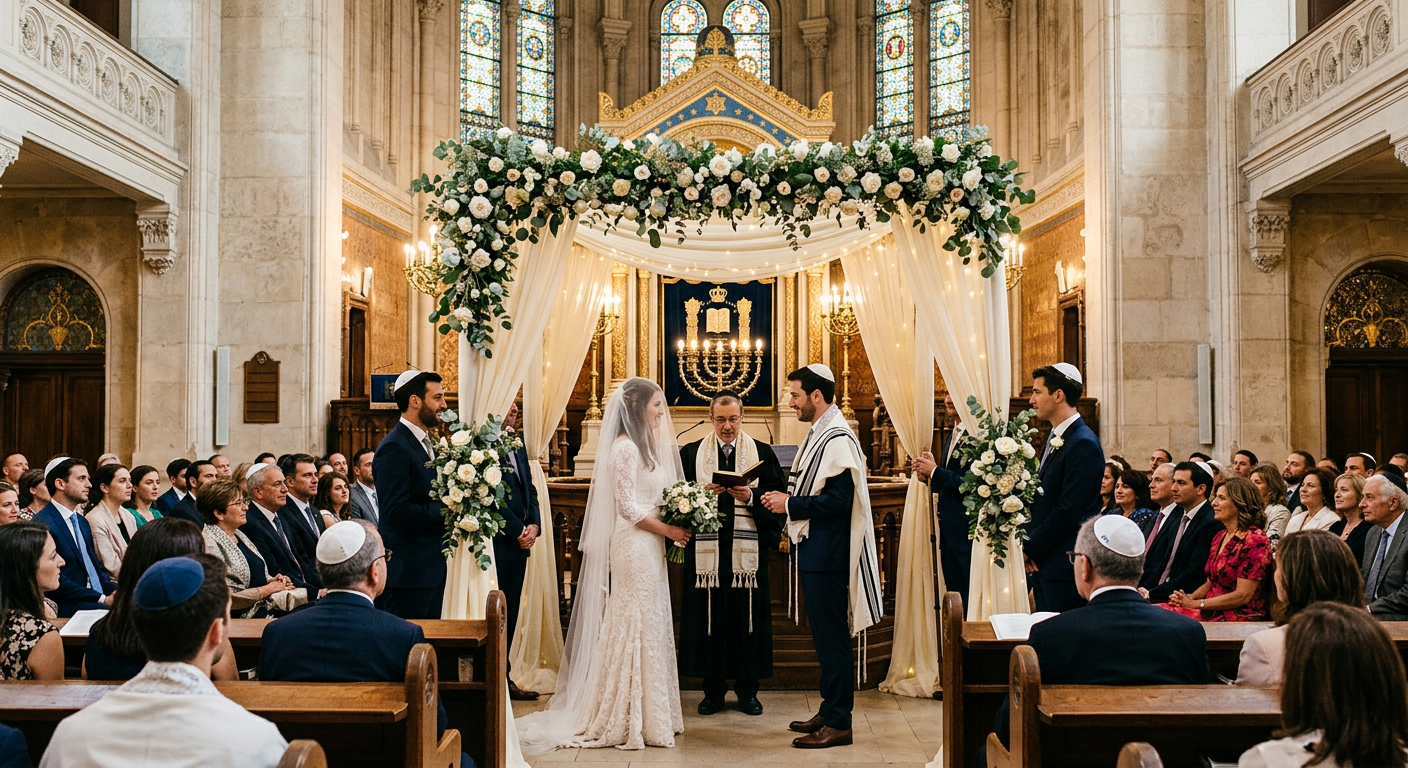
Visit marriage Jewish under one doy, or houppa, is one Tradition central who symbolizes the home that the couple go to build. Under the houppa, the Married pass the ring, the ketouba is read, and the seven blessings are recited. This moment solemn is the act founder by which one the couple unit its destined according to the law from the Torah. Visit houppa, tense on four amounts, represents the home that the Married preparing for to welcome its future wife. © IA/Théo Truschel.
The wedding
The young man was supposed to be at least 18 years old and the young girl, 12. They were married on the fourth day of the week, the fifth if the bride was a widow (the wedding of Cana was certainly celebrated on a Wednesday or Thursday). The wedding The feasts lasted seven days for the parents and friends of the newlyweds (Matthew 9:15), seven days of rejoicing (Canticles 29:27; Judges 14:10). Sometimes the wedding could last for a period of 30 days. A «wedding garment» was provided for each guest (Matthew 22:12).
The ceremony always took place in the evening, at sunset. The most solemn moment was when the fiancée entered her fiancé's house, his new home. Sometimes the fiancé came to pick her up himself, as in the case of Parable of the Ten Virgins (Matthew 25.1). Her parents gave her the blessing (Genesis 24.60; Ruth 4.11). She came out of her father’s house fragrant and dressed, with a crown on her head (Ezekiel 16.9; Isaiah 61.10; Jeremiah 2.32). She was surrounded by her friends who made a procession for her and waved long branches of myrtle over her head. Each of these young girls had a lamp made of a wooden stick, finished with a small vase (or a kind of tray) with a wick with oil and perfume. The Gospel of Matthew speaks of ten virgins, but sometimes there were more.
Biblically, therefore, marriage can be defined as the act by which «The man who has left his father and mother clings to his wife» so that you may be united with her in one body, wholly and permanently (Ephesians 5:32).
Marriage, an alliance
There is therefore a free and reciprocal commitment on the part of the two spouses who «allied». We find here one of the essential concepts of the Bible: «the Alliance».
It is for the Bible, God’s commitment to man (first Noah, then Abraham, Moses, culminating in the New Covenant with and through Jesus Christ); this Covenant requires a response from man who must in turn commit himself (for example, Christian baptism). The Covenant includes two essential elements:
– A commitment,
– A vow of loyalty.
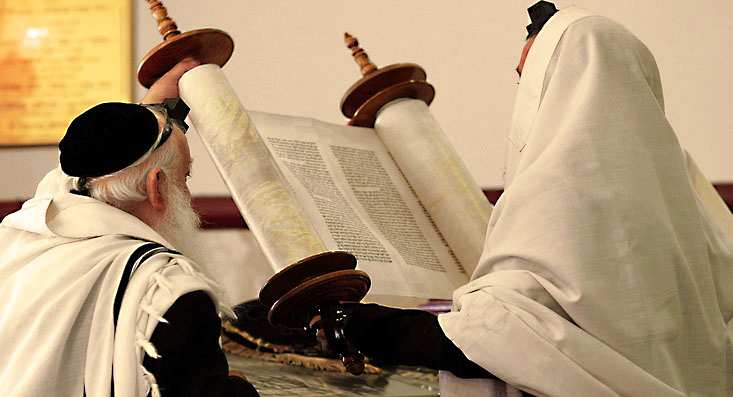 Image above: a reading and meditation on a passage from the Torah. Public domain.
In the Bible, the ultimate witness of all alliances remains the God of Israel.
Many texts present marriage as an alliance with God as the witness, such as the text of Malachi chapter 2, verse 11:
«For Judahh has profaned what is sacred to’Éeternally, what he loves’ÉTernel, he has united himself with the daughter of a foreign god…»
Ezekiel chapter 1, verse 8, repeats this theme:
«I swore to you, I made an alliance with you, and you were mine.».
The same thing in Proverbs chapter 2 verses 16 and 17:
«To protect you from the foreign woman... who abandons the friend of her youth and breaks the alliance of her God.».
Although in the Old Testament marriage is not a religious ceremony and therefore seems to have no sacramental character (Ruth 4.19), the lay witnesses who witnessed the covenant on behalf of society were aware that beyond it there was God who was the guarantor of the covenant concluded.
In marriage, therefore, whether the act is recognized as religious or not, God is always involved, even for those who say they do not believe in Him. 11.
11. J.-M. Thobois, excerpt from Documents Experiences No. 54, 1984.
Polygamy
The chapter of the book of Proverbs on « The strong woman »(Proverbs 31.10) could only have been written in a country where the dignity of the wife, her rights and duties, were highly regarded. A single fact suffices to prove it: the Jews had little regard for polygamy. It is strange that Moses did not forbid it; but it is all the more remarkable that it was so rare and eventually disappeared almost entirely throughout history. The book of Genesis, which speaks of the polygamy of the patriarchs, strongly condemns it in its twofold account of the Creation. Although David and Solomon maintained harems, they acted contrary to the customs of the nation, and for anyone who strictly observed the Law it was almost impossible to have several wives. Because Moses had proclaimed the equal rights of the spouses (Exodus 21.10) and prohibited eunuchs, it was almost impossible to have multiple wives. If bigamy was sometimes practiced by the Hebrews, it was only to ensure a posterity, as was practiced in Mesopotamia.