



Bible, History, Archaeology
History,
Archaeology
The Nash papyrus
from the Old Testament
Contents:
Intro - The Nash papyrus
ONE OF THE OLDEST MANUSCRIPTS
 The Nash papyrus
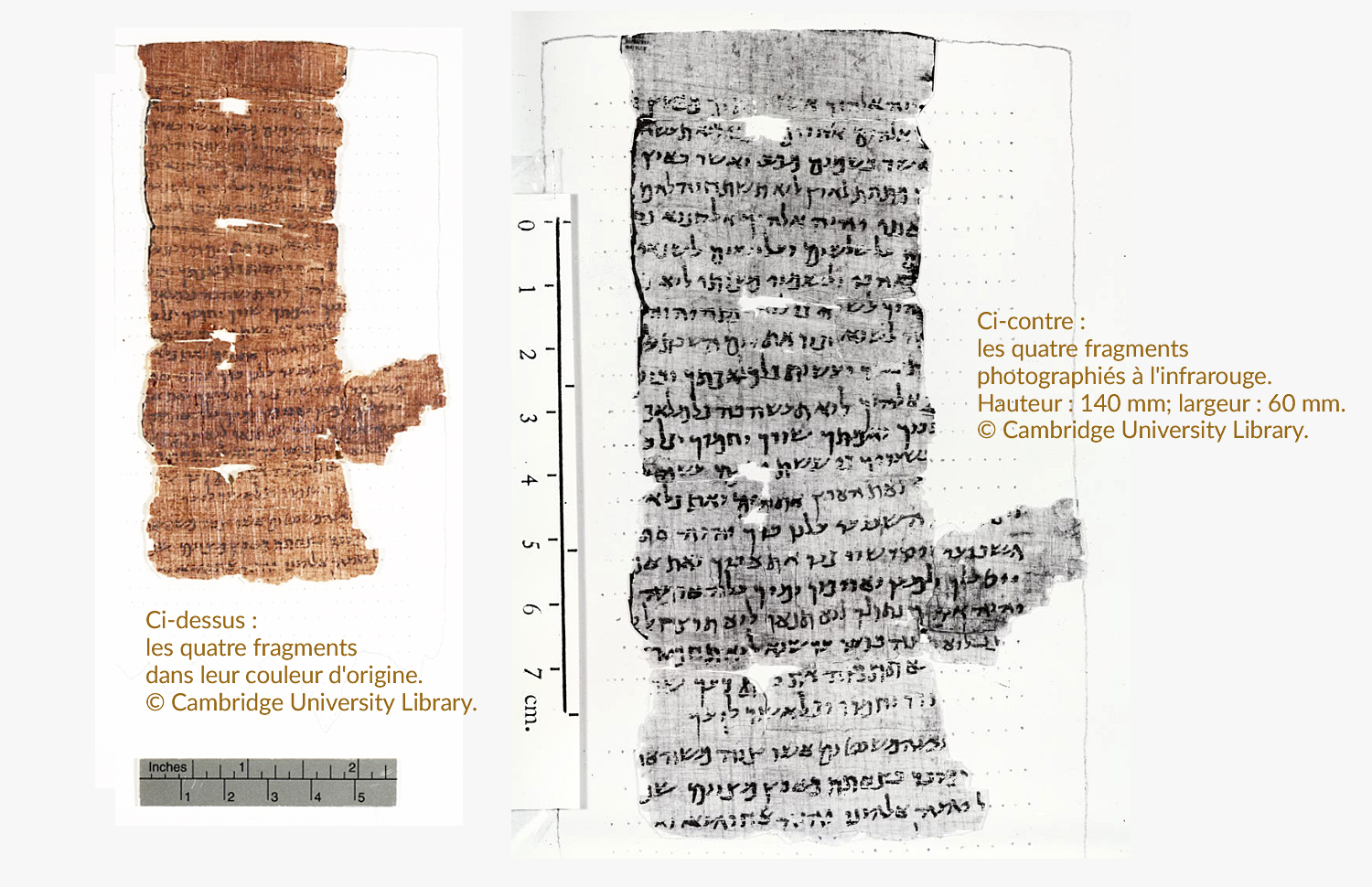
The famous Nash papyrus (MS Or 233) consists of four fragments acquired in Egypt by Dr. Walter L. Nash, secretary of the Society Biblical Archaeology at the end of the 19th century. Its precise origin is unknown. Researchers believe that the papyrus originated in the Fayoum region. It is currently on display at Cambridge University Library.
Image opposite: Scribe transcribing the Torah in the 1930s © Library of Congress. Orthodox Jewish scribe, Shlomo Washadi, writing the Torah on parchment.
Description
The Nash papyrus contains passages from Exodus 20:2-17 or Deuteronomy 5:6-21 and Deuteronomy 6:4-5 corresponding to the beginning of the Shema. The format of the document is a leaf from a written medium that has disappeared. It does not have the characteristics of a parchment fragment, let alone a Torah parchment. According to scientists, this is a compilation of various texts assembled for liturgical or pedagogical purposes (watch the video).
The four fragments were first described by historian Stanley A. Cook in 1903. Cook dated them to the 2nd century, but palaeographic analysis now suggests that they date back to the Maccabean period between 165 and 137 BC. Until the discovery of the Qumran manuscripts in 1947, the Nash papyrus was considered the oldest known Hebrew manuscript.
Twenty-four lines long, with a few letters missing from each edge, the papyrus contains the Ten Commandments followed by the beginning of the prayer «Shema Israel» Listen, Israel.. This fundamental text of Jewish prayer proclaims the absolute unity of God. It is recited every morning and evening. 1. There are a few anomalies in the passage of the Ten Commandments in the Egyptian document. In the Nash papyrus, the sixth and seventh commandments have been reversed. Furthermore, the expression «house of bondage» for Egypt is omitted. Could this have been written in Egypt?
1. For the pious Jew, the Shema is placed in a case, which is attached to the right-hand doorframe of his home. This case is called a «mezuzah».

Listen Israel, the Lord is our God, the Lord is ONE
(Rabbinate version).
The verse of the Shema Israel punctuated according to the rules of the Massorah. The letters ayin and dalet, larger than the other characters, form the word ‘Ed («witness»).
Certain anomalies from the papyrus can be found in the biblical Septuagint version, the Torah translated into Greek at the initiative of the founder of the Library of Alexandria. He advised the Egyptian king Ptolemy II Philadelphus (285-246) to bring in «competent sages» to establish a translation of the Jewish sacred text accessible to the greatest number.
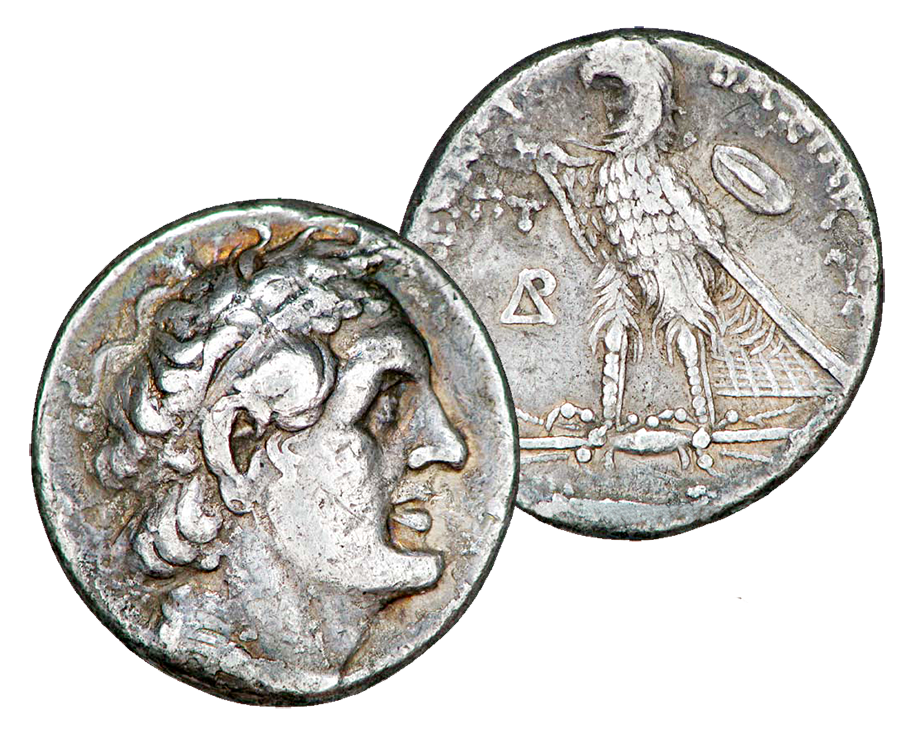
Image opposite: A silver tetradrachm depicting the diademed bust of Ptolemy II Philadelphus. Egypt, Lagid Kingdom (285 – 246 BC). He completed the Lighthouse of Alexandria.
© CGB.FR NUMISMATICS.
The insane project was to translate a language that does not use the verb "to have," has no present indicative form of the verb "to be," and uses single words to evoke multiple meanings. The Septuagint text is therefore an original production created from the Torahic foundation.