



Bible, History, Archaeology
History,
Archaeology
The Cylinder of Cyrus the Great
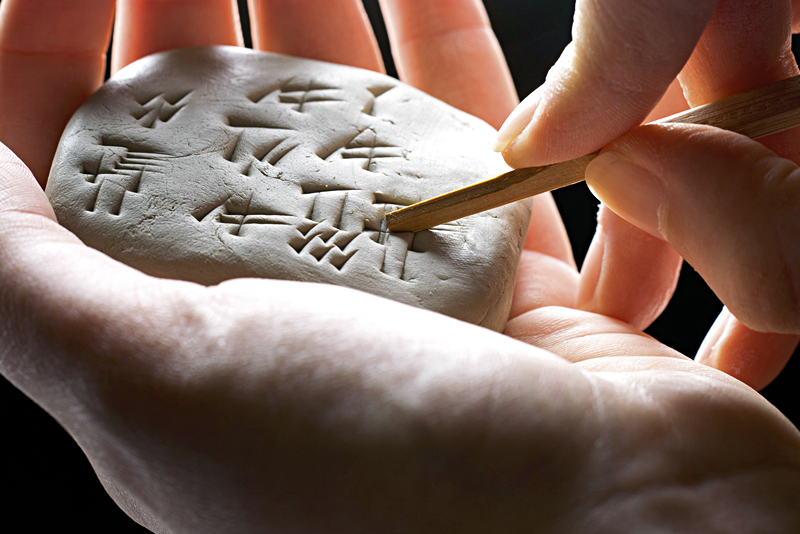 The Cyrus Cylinder (also called the «Edict of Cyrus») is one of the most famous artifacts of antiquity.
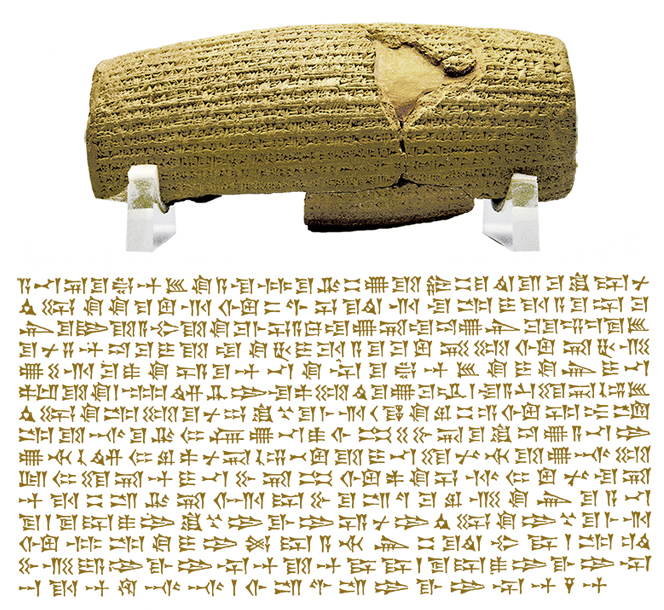
This is a cylinder of baked clay, barrel-shaped, approximately 23 cm long and 10 cm in diameter, covered with an inscription in Akkadian (Babylonian) cuneiform script.
Image opposite: cuneiform writing takes its name from the wedge-shaped lines printed by a calamus on soft clay. From the Latin cuneus meaning «wedge». Public domain.
 Discovery and conservation
This cylinder was unearthed in 1879 by the Assyriologist Hormuzd Rassam during excavations at Babylon (in present-day Iraq) on behalf of the British Museum, where it is conserved today (under number BM 90920). It was broken into several fragments; a missing fragment was identified later, and it is known today that several copies of this text existed, likely disseminated throughout the Persian Empire.
Image opposite: the Cyrus Cylinder with its inscription in
Akkadian mentions the possibility for exiles to return.
in their countries. © Théo Truschel.
This cylinder appears to be a typical foundation inscription from Mesopotamia: it was intended to be buried in the walls or foundations of a restored building to commemorate the king's work and obtain the favor of the gods.
Historical background
 In 539 BC, Cyrus (founder of the Achaemenid Empire) conquered Babylon without major fighting, thus ending the Neo-Babylonian Empire (also called the Chaldean Empire, 626-539 BC), founded by Nabopolassar, the father of Nebuchadnezzar II, the destroyer of Jerusalem and its Temple. Babylon was then ruled by King Nabonidus, who was absent that day, and his son Belshazzar, to whom the prophet Daniel revealed the meaning of an inscription that suddenly appeared on the wall of the royal palace hall during a feast (Daniel 5:25-30). The Bible reports that Daniel was then rewarded and designated as « »the third place in the kingdom's government" (after Nabonidus and Belshazzar).
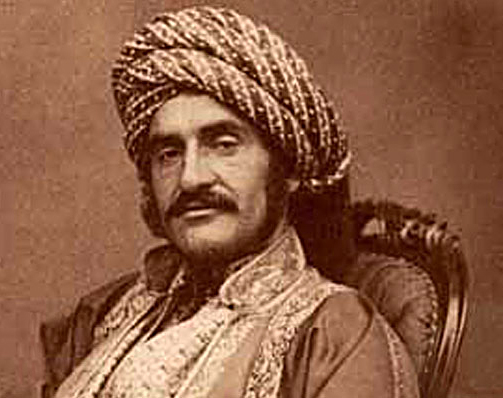
Image opposite: archaeologist Hormuzd Rassam. DR.
Cyrus, a Persian king from Anshan, incorporated Babylon into his empire, which became the largest in the known world at the time (stretching from Central Asia to the Mediterranean).
Text content
The text (approximately 45 lines, incomplete at the end) is written from a Babylonian perspective and follows a traditional Mesopotamian style. It is divided into several sections:
Critique of Nabonidus The previous king is depicted as an impious tyrant who neglected the worship of the god Marduk, imposed excessive corvée labor, and moved the statues of the gods within Babylon.
Divine intervention The god Marduk, displeased, chooses Cyrus as his instrument to restore order. Cyrus enters the city peacefully.
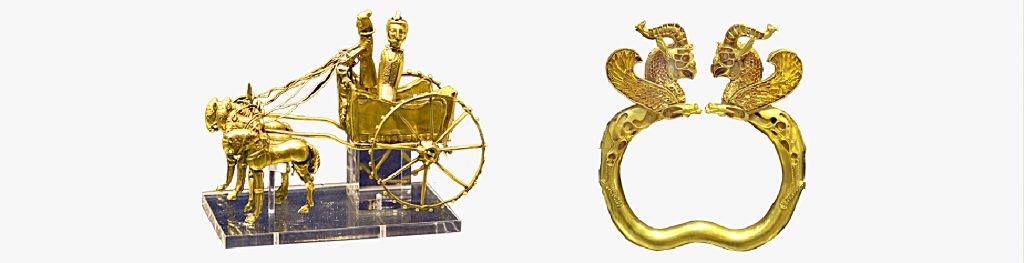
Several elements from the Achaemenid Oxus Treasure.
A model of a golden chariot pulled by four horses and a gold bracelet. 6th century BCE.
Cyrus's Actions He presents himself as a just and pious king. He restores temples, returns the statues of the gods to their original sanctuaries, and ends abusive corvée labor., allows deported populations to return home and rebuild their homes. He respects local customs and governs with benevolence.
Genealogy and legitimacy Cyrus claimed to be descended from an ancient royal lineage and beloved by the Babylonian gods (Bel and Nabû).
Famous excerpt (approximate translation):
«I am Cyrus, king of the world, great king, powerful king, king of Babylon, king of Sumer and Akkad, king of the four corners. […]
I entered Babylon peacefully […] I have inquired about the well-being of Babylon and all its sanctuaries.
[…] I brought back the deities who had resided there [in Babylon] and made them a dwelling for eternity. I gathered all their inhabitants and restored their dwellings.»
The cylinder does not explicitly mention the Judeans exiled in Mesopotamia, but it does speak of the return of peoples deported within the empire and the restitution of their possessions and deities.
This remarkably corresponds to the biblical account where Cyrus authorizes the Israelite exiles to return to Jerusalem and rebuild the Temple (Isaiah 44/24-28; 45/1-4; 2 Chronicles 36/22-23). The Bible also recalls that he returned all the gold temple utensils taken to Babylon by Nebuchadnezzar as a sign of compensation (Ezra 1/1-11; 5/13).
Cyrus is even designated as « Lord's point »In the scriptures, an exceptional and unique honor for a non-Jew.
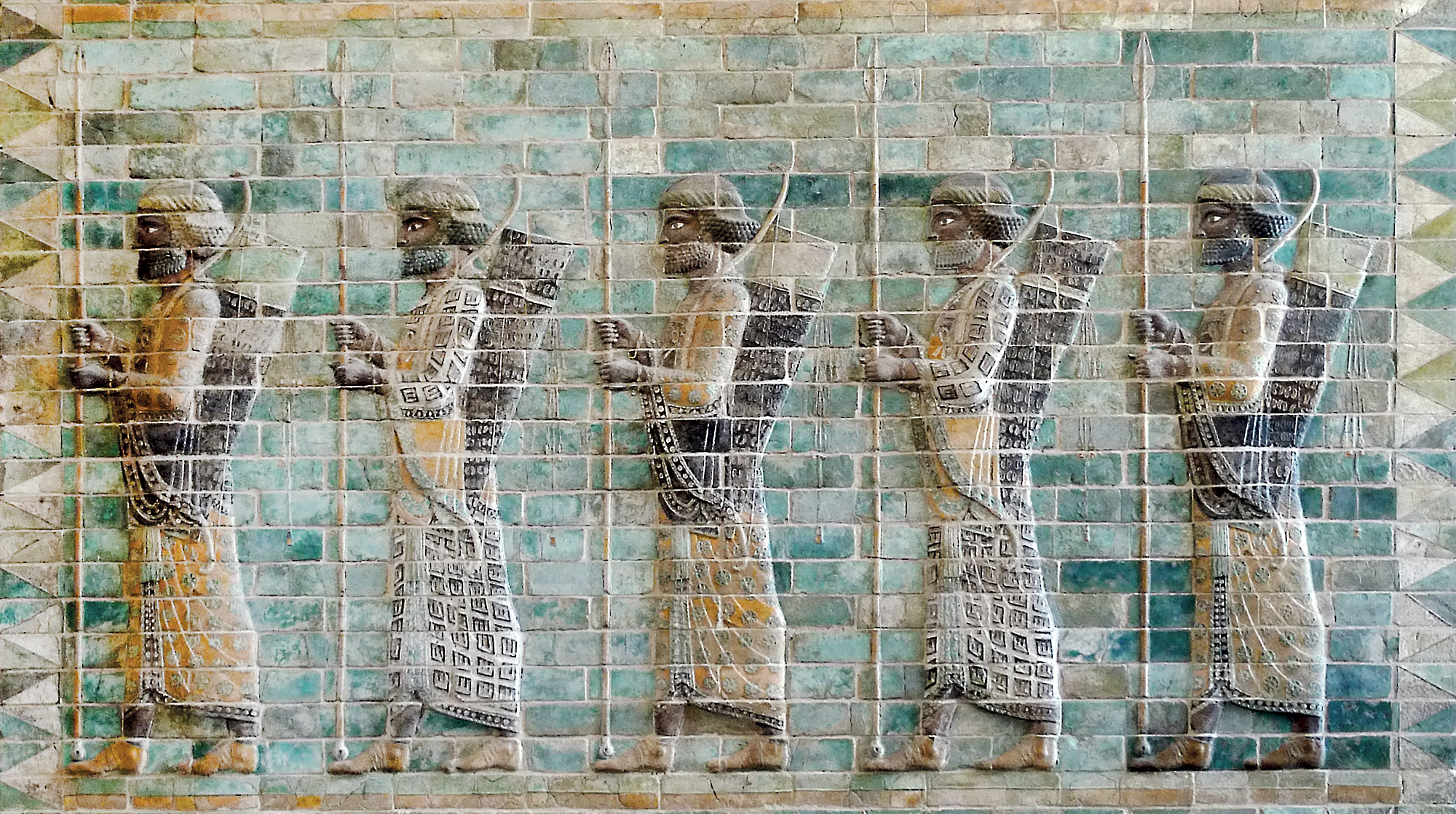
The great frieze of archers or the “Immortals”
The Achaemenid Persian Empire is represented in the Louvre collections by elements of the sumptuous polychrome decoration of the palace built by Darius I in Susa (circa 525-486 BC). The molded, glazed brick reliefs, which make up this unique ensemble, were brought back by M. Dieulafoy, who discovered them in 1885 and 1886, during his exploration of the palace. © Théo Truschel.
Meaning and interpretations
For historians: This is an excellent example of intelligent royal propaganda. Cyrus adopted Babylonian language and traditions to legitimize his power among the local populations. He practiced a policy of religious and cultural tolerance, which contributed to the stability of his immense multiethnic empire. This is not a «universal declaration,» but a local proclamation typical of Mesopotamian kings, with a dimension of restoration and piety.
Nevertheless, it remains a remarkable testament to tolerance and inclusive governance within a conquering empire, well before other similar models.
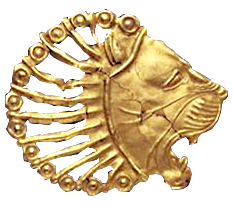
Gold jewelry. 6th century B.C. Leiden Museum © Théo Truschel.
Gold jewelry. 6th century B.C. Leiden Museum.
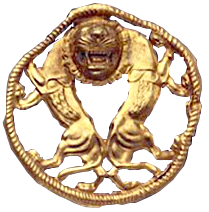
Gold jewelry. 6th century B.C. Leiden Museum © Théo Truschel.
Gold jewelry. 6th century BC.
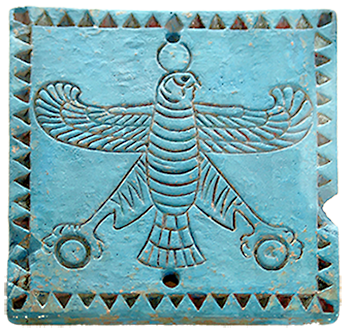
Standard of Cyrus II © Museum of Teheran, Iran.
Standard of Cyrus. Museum of Teheran, Iran.
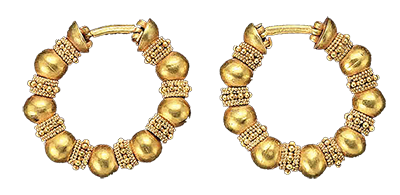
Earrings. 4th / 5th century B.C. © D.R.
Earrings. 4th / 5th century B.C.