



Bible, History, Archaeology
History,
Archaeology
Hezekiah's Seal
Contents:
Introduction - The discovery - The seal inscription - Seal motifs - The reign of Hezekiah - Image gallery
Introduction
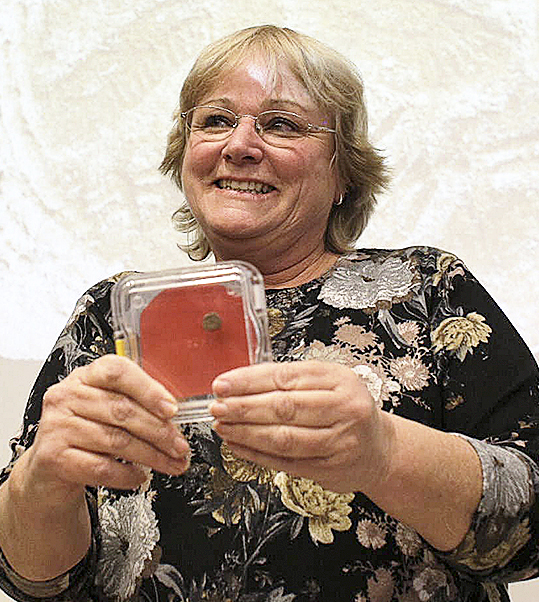 On December 2, 2015, archaeologist Eilat Mazar (1956-2021) of the Hebrew University of Jerusalem, revealed in a press release an exceptional piece of information: the deciphering of the imprint of a seal unearthed in 2009 and bearing the mention of a biblical king, Hezekiah, who reigned in Jerusalem some seven hundred years BC.
Image to the right: Eilat Mazar during the press presentation of the bulla of Hezekiah. Public domain.
The discovery
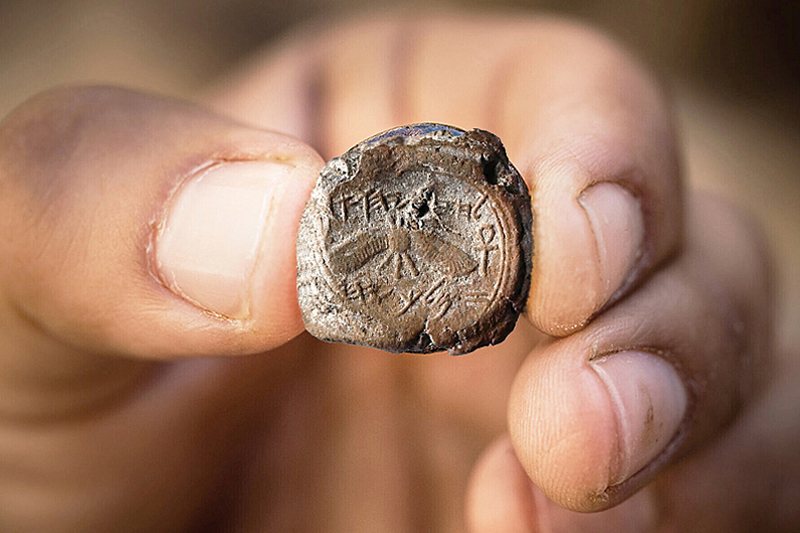
This is the first time a clay seal mentioning a king from the Bible has been unearthed during officially declared archaeological excavations. Under the direction of archaeologist Eilat Mazar, excavations conducted at the foot of the southern wall of the Temple Mount, in the Ophel neighborhood of Jerusalem, yielded this seal impression, printed on a «clay bulla,» in 2009. The object is tiny, measuring only thirteen millimeters wide, twelve millimeters high, and three millimeters thick. According to custom, seals were used to mark correspondence issued by important figures; they usually bore motifs or signs identifying the owner. To seal a document, the seal had to be pressed into a malleable surface such as fresh clay.
From the earliest times, documents were written on clay tablets, and the seal was simply affixed at the end of the text, like a signature at the bottom of a letter. The use of clay tablets was common in Mesopotamia and extended as far as Egypt. Seals were usually cylindrical in shape, and the seal was unrolled onto the tablet to transfer the design.
Image opposite: a view of Hezekiah's seal. Public domain.
But the seal whose imprint was discovered in Jerusalem is of a different type: it is an oval-shaped stamp, which was likely set in a ring and used like a tampon. The documents thus authenticated were not cuneiform tablets, but scrolls of papyrus or parchment, tied with a knotted string and then sealed with a clay bulla that was stamped with the seal.
Traces of the original papyrus are still visible on the back of the bulla.
The seal inscription
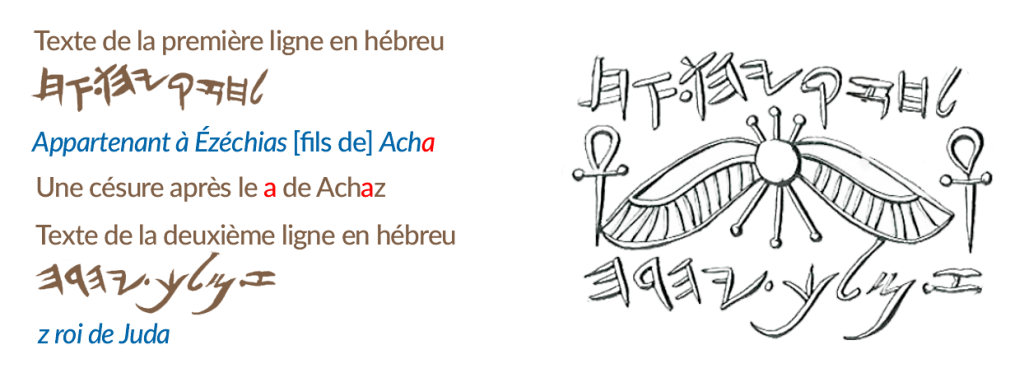
The impression, which can be seen on the drawing of the bubble recorded by Robert Deutsch, comprises three registers. The upper and lower registers contain paleo-Hebrew letters, while the central register features two Egyptian motifs.
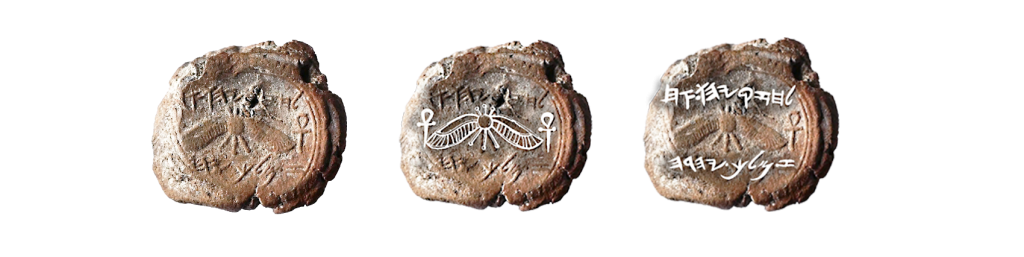 The impression visible on the seal comprises three registers. The upper and lower registers contain Paleo-Hebrew letters, while the central register features two hieroglyphic motifs. © Montage by Théo Truschel.
With the kind permission of Robert Deutsch and Michael Langlois.
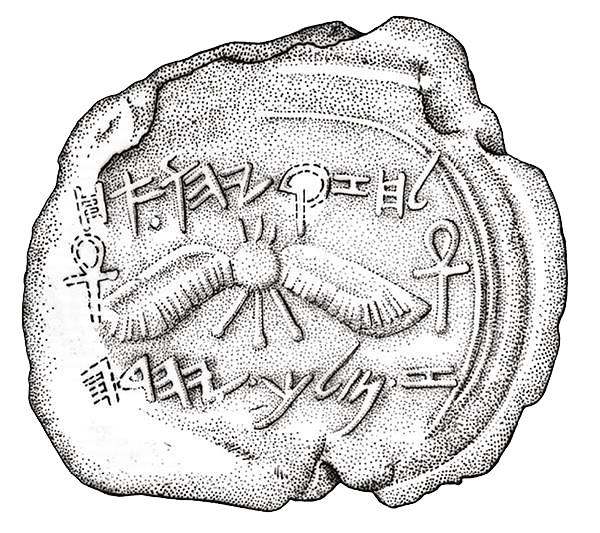 The use of paleo-Hebrew letters dates back to the 10th/9th century BCE, long after «Asiatics» (Semites east of Egypt) adopted Egyptian hieroglyphs in the 2nd millennium and transformed them into alphabetic signs. The oldest known example is the script called «Proto-Sinaitic» by scientists. Alphabetic writing developed slowly over the centuries and gradually gave rise to more than a dozen different alphabets represented on the shores of the Mediterranean: Phoenician, Hebrew, Aramaic, Greek, Latin, and others. The alphabetic system was a true revolution because it allowed for a simpler and faster practice of writing.
Image opposite: the drawing of Hezekiah's seal with its three registers.
With the kind permission of Robert Deutsch and Michael Langlois.
Seal motifs
The central registry of the seal features two figures, curiously taken directly from Egyptian mythology: ankh, also called ânkh, which represents life in Egyptian hieroglyphs, and a sun at its zenith, surrounded by rays and with two large wings spread in a sign of protection. This image normally represents one of the main Egyptian deities, the sun god Laugh (« the one who makes »), later associated with Atum, the creator sun god.
What are these Egyptian motifs doing on King Hezekiah's seal?
From the second millennium BCE, the Levant was under the influence of the powerful Egyptian empire, its civilization, and its culture, which spread everywhere.
The case of this Hezekiah seal impression is not unique. In 1986, a bulla bearing the exact same inscription and motifs, dated to approximately 728-699 BC, was discovered. However, its unknown provenance – it was not unearthed during regular archaeological excavations – cast doubt on its authenticity.
In fact, to date, a number of seal impressions bearing the inscription have been found:
«Hezekiah's, sons of Ahaz, king of Judah.
The discovery of this imprint confirms the historical existence of King Hezekiah of Judah. This time, we have a royal inscription whose provenance is attested. It is added to the growing body of archaeological data showing the reliability of the historical framework of biblical narratives for the period of the kingdoms of Israel and Judah.
The reign of Hezekiah
The translation of the paleo-Hebrew inscription from the Jerusalem bulla, published by E. Mazar, reads: «To Hezekiah, sons of Ahaz, king of Judah ». King Hezekiah is mentioned in the Bible starting in the Second Book of Kings (16:20): «Ahaz slept with his fathers and was buried with his fathers in the city of David. Hezekiah, his son, reigned in his place.».
According to Bible historians, Hezekiah likely reigned over the Kingdom of Judah from approximately 728 to 699 BC. There was a co-regency of about two years before Ahaz's death.
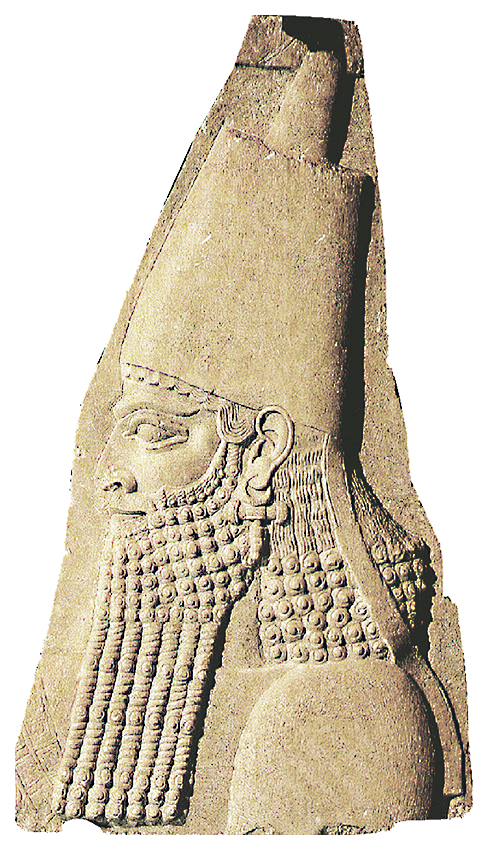
Image opposite: relief fragment depicting Sargon II, gypsum alabaster.
Height 89 cm. © Egyptian Museum, Turin.
The Bible describes Hezekiah as a religious reformer who restored order to worship in the Temple of Jerusalem. He often consults the prophet Isaiah. During his reign, the city of Jerusalem grew and welcomed numerous Israelite refugees who came to settle in Judah after the fall of the Northern Kingdom to the Assyrians led by Shalmaneser V and then by Sargon II (the conquest of Samaria in 722 BCE).
Hezekiah, anticipating a siege of Jerusalem, expanded the city's fortifications and dug a tunnel from the Gihon Spring to the Pool of Siloam (533 m).
It is called Hezekiah's Tunnel today and it provides a water supply (2 Chronicles 32:2-4; 2 Kings 20:20).
Upon the death of Sargon II (-705), his son Sennacherib ascended the throne while uprisings surfaced. But Sennacherib, in a campaign to the West, subdued Phoenicia (-701). Ammon, Edom, and Moab paid their tributes. Hezekiah, leader of the rebels, submitted in turn after the capture of Lachish (2 Kings 18:31); he was forced to pay a heavy tribute.
Later, during a new rebellion of the Philistines and Egypt, Sennacherib laid siege to Jerusalem (-690), but his army was decimated by a disease that could be a form of plague (2 Kings 19:35-36).