Bible, History, Archaeology
History,
Archaeology
Home > Artifacts > NT artifacts >
Papyrus P52
of the John Rylands Library
Contents:
Introduction - Archaeological digs - The discovery - The double-sided papyrus - Duplex translation - Dating
 Introduction
Papyrus is a type of fragile plant-based paper made from the reed, a plant that grows in Egypt and in some marshes in Lebanon. As far as we know, there are currently about a hundred papyri containing fragments of the New Testament. Due to the fragility of this material, none of these precious manuscripts containing the entire New Testament have survived to our time.
There are several types of manuscripts:
– Texts written on papyrus. Most were found in certain desert regions of Egypt.
– Parchment manuscripts; they cover a period up to around the 9th century. They are written in Greek capitals.
Manuscripts dating from around the 8th century onwards that are written in cursive Greek (minuscule) letters.
Archaeological digs
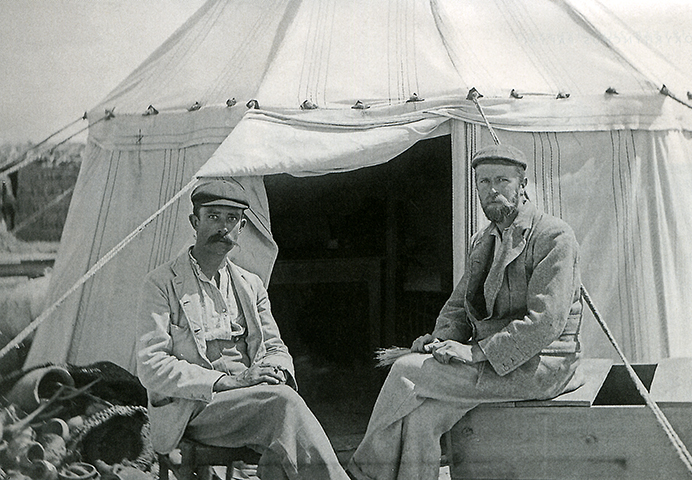 In the early 20th century, as two young English scientists, B.P. Grenfell and A.S. Hunt, were excavating piles of ancient rubble in the Faiyum region of Egypt at the famous site of Oxyrhynchus, they unearthed very old papyrus fragments. It is only in such hot and dry regions that this delicate material remains more or less intact. The sand dunes caused by the wind do the rest by preventing the writing from fading in the sunlight.
Image above: The two English scientists B.P. Grenfell and A.S. Hunt at the site of Oxyrhynchus in the Faiyum region. D.R.
The two researchers took their discoveries to England, where they were deciphered little by little. These fragments provided a glimpse into daily life in Egypt, about two thousand years ago.
The discovery
But it's a very small fragment of papyrus, acquired in 1920 by Bernard P. Grenfell, the size of the palm of a hand (about 9 x 6 cm), that was to make him famous.
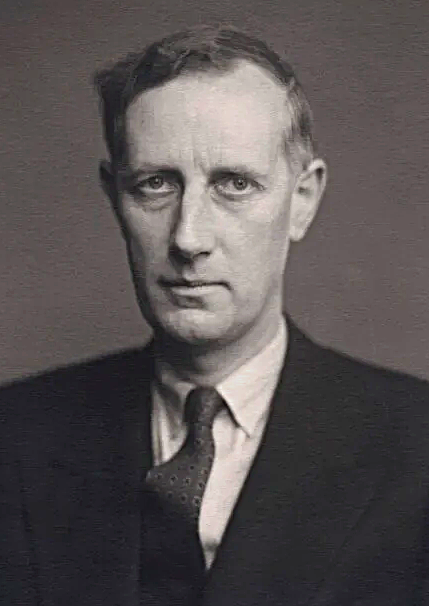 Image opposite: Professor C.H. Roberts (1909-1990).
He participated in excavations at Karanis in the city of Medinet el-Fayoum, organized by the University of Michigan, and published some biblical papyri in the collections of the John Rylands Library. DR.
In 1935, while sorting old Greek papyri for the John Rylands Library, Professor C.H. Roberts of Oxford University discovered among these findings a papyrus fragment containing seven lines of one hundred letters written in ancient Greek, on the front and back. This was enough to identify them without ambiguity: verses from the Gospel of John: John 18:31-33 on the front and John 18:37-38 on the back.
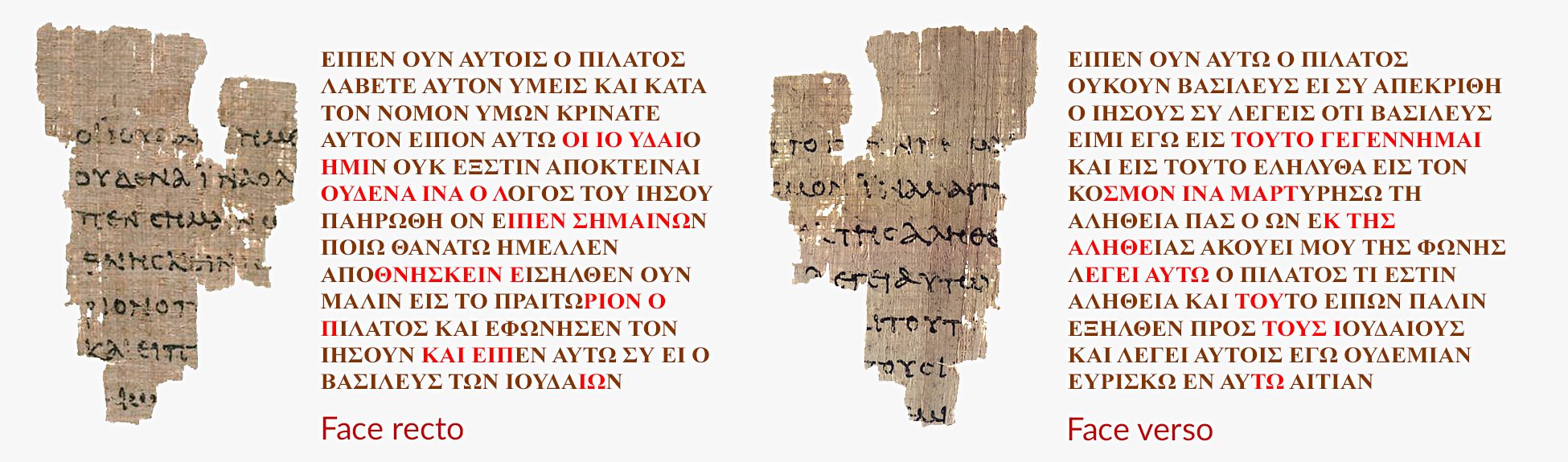
Face up
The letters in red are visible on the exhumed fragment; the letters in black are reassembled.
So Pilate said to them, "Take him yourselves and judge him by your own law." The Jews answered him, "We are not allowed to put anyone to death." This was to fulfill the word that Jesus had spoken to indicate the kind of death he was to die. So Pilate entered the headquarters again and said to Jesus, "Are you the King of the Jews?"
18 Then Pilate said to them, "Take him yourselves and judge him by your own law." The Jews said to him, "We are not allowed to put anyone to death." This was to fulfill the word that Jesus had spoken to indicate the kind of death he was to die. 33 So Pilate entered the palace again and called Jesus and said to him, "Are you the King of the Jews?".
Back face
The letters in red are visible on the exhumed fragment; the letters in black are reassembled.
Pilate said to him, "So you are a king?" Jesus answered, "You say that I am a king. For this I was born, and for this I came into the world, to bear witness to the truth. Everyone who is of the truth listens to my voice.".
Pilate said to him, "What is truth?" After he had said this, he went back out to the Jews and said to them, "For my part, I find no guilt in him.".
John 18:37-38
Dating
The date of its origin could also be determined with certainty: between 98 and 138 AD.
With this fragment, we had found, to date, what was then the oldest known manuscript fragment of the New Testament.
According to tradition, the apostle John is said to have died at an advanced age, around the end of the 1st century AD, in Asia Minor (perhaps in Ephesus?), shortly after writing his Gospel, his Epistles, and the Apocalypse. If a copy of the Gospel of John had reached Egypt twenty to thirty years later, as this exceptional discovery seems to prove, then its importance can truly be grasped. This fragment demonstrates the rapid spread of Christianity into areas far removed from its land of origin.
This witness text is kept as a precious treasure in the John Rylands Library in Manchester (England) under the scientific designation P52. Its text is so short that it does not allow us to compare it with complete versions of the same Gospel that appeared later. This Gospel fragment is said to come from a codex a square of about 20 centimeters that was supposed to contain the entire Gospel of John, or about 66 sheets or 132 pages in total.
It is remarkable that the papyrus fragments found (dating from the early 2nd to the 8th century) mostly represent the results of discoveries made only in the 20th century.
Image below: papyrus in marshes in Lebanon. D.R.