



Bible, History, Archaeology
History,
Archaeology
The Ein Gedi parchment,
a 2000-year-old manuscript
A beautiful discovery
The biblical manuscript of Ein Gedi is an ancient parchment discovered in Israel, famous for having been «unrolled» and deciphered digitally without being physically opened.
 Context of the discovery
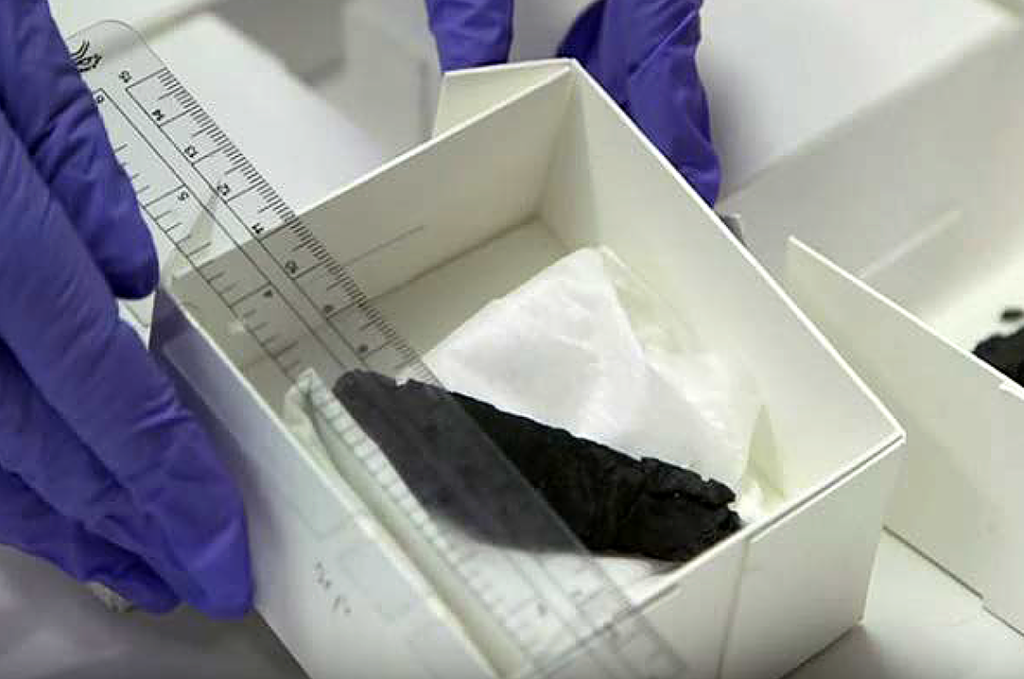
In 1970, during archaeological excavations led by Dan Barag and Sefi Porath In the ancient synagogue of Ein Gedi (near the western shore of the Dead Sea, destroyed by fire around the 6th century CE), archaeologists unearthed a carbonized and very fragile parchment fragment in the location of the Holy Ark (Aron ha-Kodesh)., see image below).
Image opposite: While awaiting a more favorable period, the discovered manuscript is carefully stored. © Le Monde Juif. Image DR.
The fragment was too damaged (burnt and fragile like charcoal) to be physically unrolled without the risk of total destruction. It has remained preserved as is for decades by the’Israel Antiquities Authority (IAA).
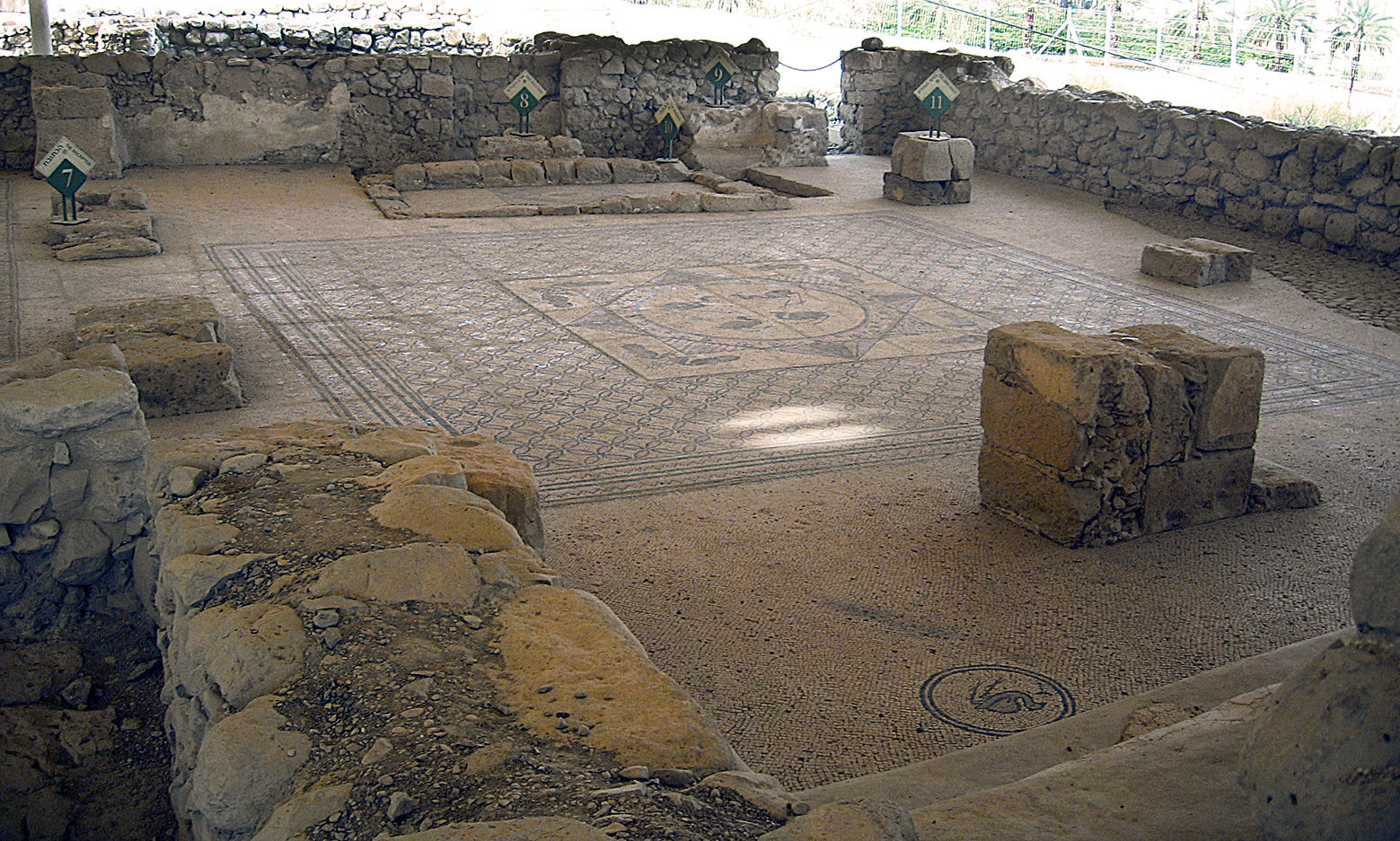
Mosaic from the Ein Gedi Synagogue. In the background, the location of the Holy Ark (Aron ha-Kodesh).
The ancient synagogue of Ein Gedi is located in the reserve of the same name in the Judean Desert. The site was already inhabited in antiquity. References to this settlement can be found in the Tanakh, but the elements discovered in the synagogue date from the Byzantine period, from the 3rd century, when the site was inhabited again after its destruction during the Bar Kokhba revolt, in the 6th century, when the site was destroyed a second time and the synagogue was burned. Personal work © Teqoah.
A new scientific discovery
In 2015-2016, a revolutionary new digital imaging technique revealed what was written inside using micro-computed tomography: a passage from a text in ancient Hebrew from the Book of Leviticus, approximately two thousand years old. This analysis allowed scientists to read the content of this fragile fragment., made of animal skin, digitally “unrolling” it without having to open it, thus without risking altering it. According to Emmanuel Tov, of the Hebrew University of Jerusalem, a specialist in the Dead Sea Scrolls, this text shows a text of 35 lines in each column, of which 18 were preserved and 17 were reconstructed, is identical to the Masoretic Hebrew version (Jewish scribes), which remains the official basis of Judaism and a reference for modern translations.
The region's hot, dry climate had allowed for the preservation of several papyrus fragments, but when they were discovered, the first manuscripts crumbled to dust as soon as the archaeologists touched them. The preserved scrolls were therefore carefully stored away, and remained so for almost half a century without their contents being known.
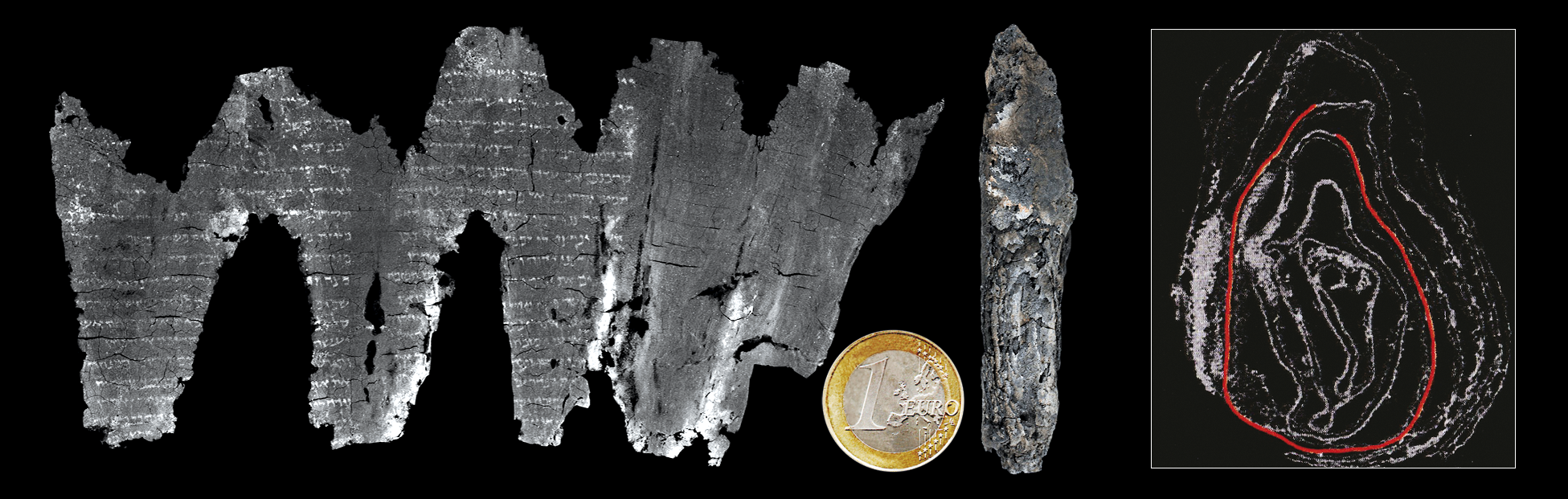
From left to right:
- the digitally “unrolled” manuscript;
- To the right of the one-euro coin, the manuscript at the time of its discovery. Or Imbar/Théo Truschel.
- On the right of the image, the internal structure of the roller digitized using X-ray microtomography. Image © D.R.
Digital unwrapping
An international team led by Professor William Brent Seales (University of Kentucky) succeeded in reading the text using a revolutionary «virtual unrolling» technique consisting of:
Micro-CT scanner (high-resolution computed tomography): the roll was scanned without significant physical contact to obtain an internal volumetric 3D image.
Layer Segmentation algorithms have identified and separated the different rolled layers of the animal skin parchment, even those deformed by fire.
Ink detection The ink containing metallic traces was spotted thanks to differences in density in the scans.
Texturing and flattening The surfaces were «textured» with the detected ink, then virtually unrolled and flattened to produce a readable image.
This method made it possible to reveal the text on several complete rolls without damaging the artifact.

A view of a waterfall in Ein Guedi National Park near the Dead Sea © Tutti Frutti.
Manuscript Content
This is a passage from the Book of Leviticus (chapter one, verses 1-8 approximately, and part of chapter 2).
It is the oldest known copy of a fragment of a Pentateuch (Torah) book discovered in a synagogue holy ark.
Dating: circa 3rd–4th century CE (shortly after the Dead Sea Scrolls).
The consonantal text is identical to that of the Masoretic tradition (standard text of the Hebrew Bible, as in the Leningrad Codex).
There are no significant variants, which confirms the faithfulness of the transmission of the biblical text.
This is a major discovery in paleography and biblical studies, as it bridges a gap between the Dead Sea Scrolls and medieval manuscripts.
A new technology
Researchers hope to use this new technology to analyze about a hundred ancient documents that are too fragile to be unrolled, such as certain Dead Sea scrolls or other papyrus scrolls buried during the eruption of Mount Vesuvius in 79 AD.
This technique should also be applicable to fields such as the more general study of antique objects, as well as forensic medicine.